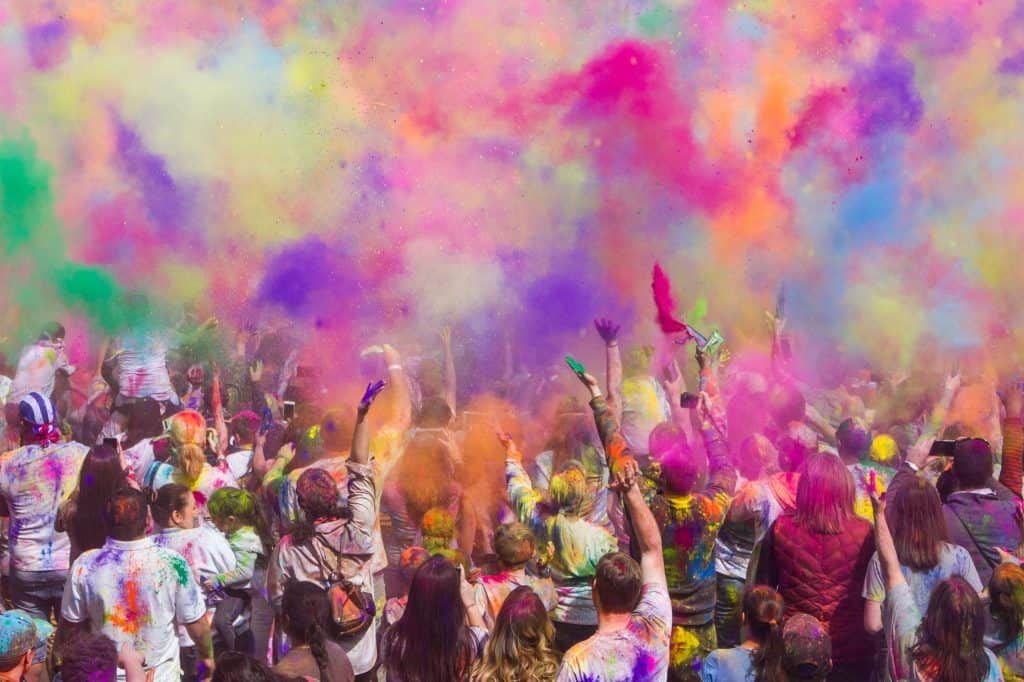
Across our Multi-Faith Network, colleagues are marking important moments in the religious calendar - including Purim and Holi, both taking place this March.This month, two of our network members Antriksh and Gavriel share their personal reflections on these traditions - two vibrant celebrations rooted in resilience, joy and the triumph of good over evil.
Celebrating Holi – Festival of Colours
By Antriksh Kaul, Indirect Tax Assistant & Network Co-Lead
Holi, often called the Festival of Colors, is one of the most vibrant and joyful celebrations in India. Celebrated across the country and in many parts of the world, Holi marks the arrival of spring and the victory of good over evil.
As per the Hindu mythology, Holi is closely associated with the legend of Prahlada and Holika. According to the legend, Holika tried to burn Prahlada in the fire, but he was protected because of his deep faith and devotion. In the end, Holika was burned instead. The bonfire reminds us that no matter how powerful evil may seem, goodness and truth always win.
In other words, the legend symbolizes devotion, faith and the triumph of righteousness.
On the night before Holi, people gather to light bonfires in a ritual known as Holika Dahan, representing the burning away of negativity. The next day is filled with color, laughter, and togetherness. Friends, families, and even strangers smear each other with powdered colours and splash colored water in a playful celebration. Streets come alive with music, dancing, and traditional sweets like Jalebi, gujiya and thandai.
Holi is more than just a hindu festival of colours, it is a celebration of Indian culture, new beginnings, forgiveness and unity. Like the quote says "bura na maano, Holi hai (Don’t mind, it is Holi)”, it encourages people to let go of past grievances and embrace love and happiness. In today’s fast-paced world, Holi reminds us to celebrate life with open hearts and vibrant spirits.
The festival of holi usually celebrated according to the Hindu calendar but usually falls in February end or March. This year (2026) it falls on 4th March.
In the UK , holi can be witnessed and celebrated in different parts of the UK, everyone is most welcome to celebrate this festival which will definitely have powdered colour, water colours, music, food stalls and dance and DJ. I will be celebrating it in Reading on the first weekend of March 2026 with friends and family, and you are most welcome to join!
Celebrating Purim
By Gavriel Wershbale, Performance Marketing Manager & Network Member
My earliest memory of Purim is from when I was maybe 4 years old, my grandma took me to the local bakery one day, as she usually did, but on that day they had a special new cookie!
Shaped like a triangle, hiding an apricot or grape jam filling in the middle, my grandmother told me the cookie was called a "Hamantaschen" - a Yiddish term which literally means "Haman's pockets" (due to the hidden "pocket" of jam in the middle of the cookie).
My grandma said they were made into triangles to mock Haman's pointy triangle hat (and/or his pointy triangle ears). I had no idea who Haman was - or why we were mocking him - until I learned the whole story of Purim when I was older.
The story of Purim recounts when 2,500 years ago, the evil Haman planned to get rid of all of the Jewish people in the Persian empire, because of a Jew named Mordecai who refused to bow to him when he passed. Little did Haman know when he made his evil plot that the Emperor’s favourite new wife Esther was herself Jewish! Through the heroic efforts of Esther and Mordecai the Emperor turned on Haman, declared amnesty for the Jewish people, and Haman himself ended up hanged.
Every year on Purim we read the Book of Esther aloud in synagogue, with much drama, and with many fun costumes (Purim essentially the equivalent of Jewish Halloween in this regard). Noisemakers are rattled, feet are stamped, and loud boos ring out from those listening to the story whenever the name Haman is read out of the Book of Esther, and likewise loud cheers and applause come whenever the heroes of the story Esther or Mordecai are mentioned.
The Book of Esther is unique among Hebrew texts in that there is never any reference to miracles or divinity in it. In the story of Purim, unlike every other Jewish holiday, G-d is not mentioned even once! Purim is a story about people doing their honest best and achieving miracles by virtue of their own efforts and actions, not through open miracles like the parting of the sea.
When I was older I realised that Purim wasn’t just about mocking Haman’s failure, but rather celebrating our survival through human efforts turned into miraculous results. I realised that the true meaning of the Hamantaschen is not about hats or ears, but that the hiding jam in the centre symbolises the miracles “hidden” in our lives and in our history.
Want to learn more about our Employee Networks?
Find out more here